115TRADING
Pre-alpha research preview

A trading harness for high-frequency retail traders.

The trader brings judgment and edge. The harness brings research, execution, risk, operations and institutional memory — so one person can run a book at a tempo that used to need a room.

Stage
pre-alpha
Capital
own book
Stack
Python · TypeScript
Latest note
Aug 6, 2026
ChartMES · 1m
The desk's chart pane: a full session of one-minute bars with the engine's trend ribbon, and the open position's entry, four take-profit rungs and stop drawn where the engine placed them.
The wall

This is the surface it runs on.

One screen, tiled into panes. The chart carries the engine’s entry, its take-profit rungs and its stop — drawn where the engine put them, not annotated afterwards. Beside it: an order ticket, a rail showing which signal conditions are true this second, the squawk, the music, the server.

Walk the desk
StrategySession state · signal conditions
The session rail: the run state of the strategy — stopped, started, armed, pilot, trading — above a grid of named signal conditions, each showing whether it is currently true and the price it last evaluated at.
TicketOrder · protect & scale
The order ticket: market, limit and stop entry, a size stepper, break-even, auto-pilot, take-profit and trailing controls, and the open position row. Account figures, size and price are masked.

Captured from the running desk. P&L, account figures and position size are masked on every screenshot on this site — we don’t publish them — and strategy parameters are removed.

What is built

Nine parts, one system.

Each of these is built, and where a part is not yet carrying live weight we say so on the card rather than in a footnote. This is what the harness does, at the level of detail we can publish without handing over the parts that took longest.

How it is built
01

The desk terminal

One screen tiled into panes — chart, ticket, session rail, squawk, music, server — that drag, split and close like windows. Every figure on them comes from the same event stream the book runs on.

02

Execution engine

An event-driven core that ingests market data, runs strategy logic and routes orders in real time, with deterministic state we can replay and audit down to the fill.

03

The walk-forward lab

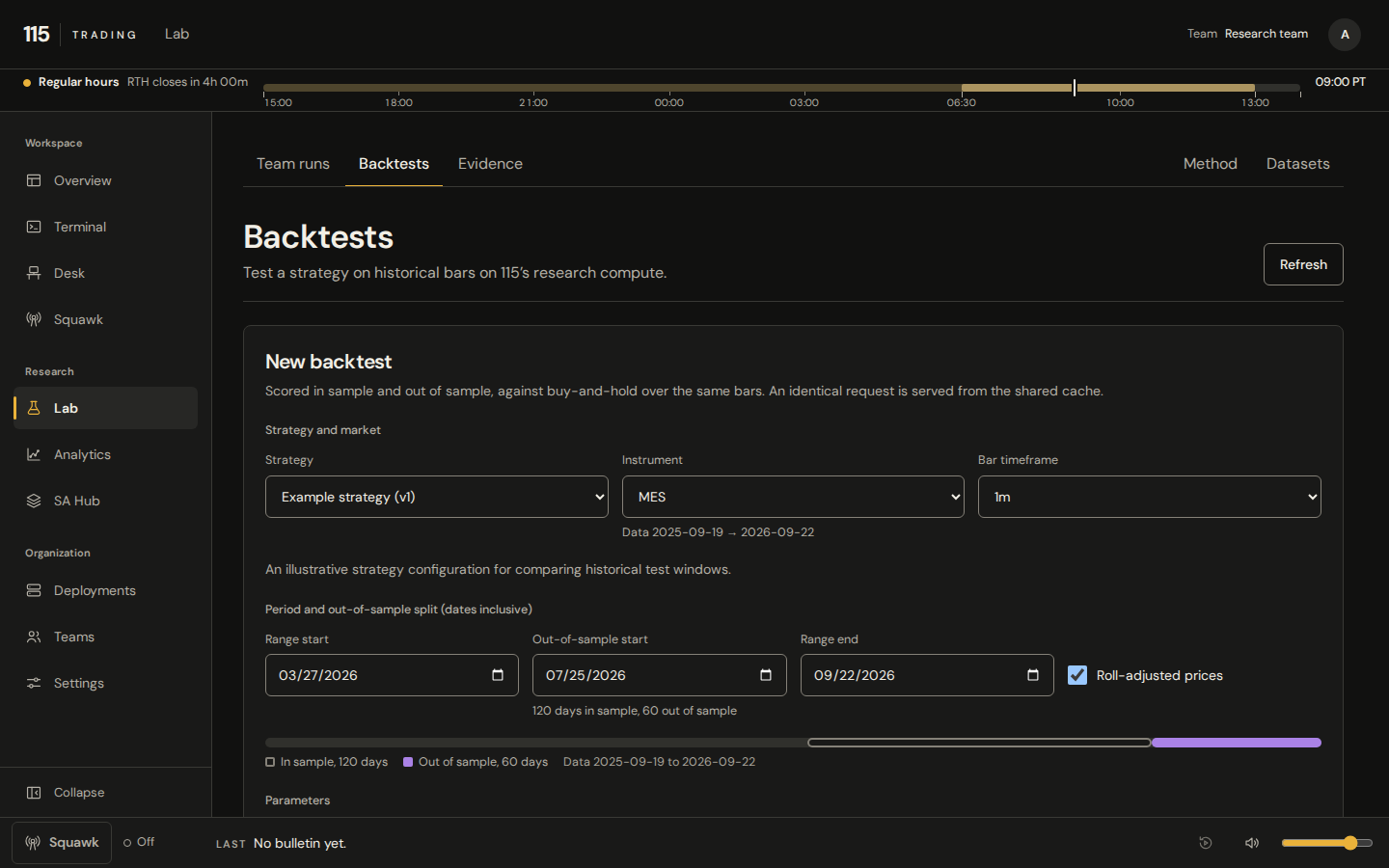
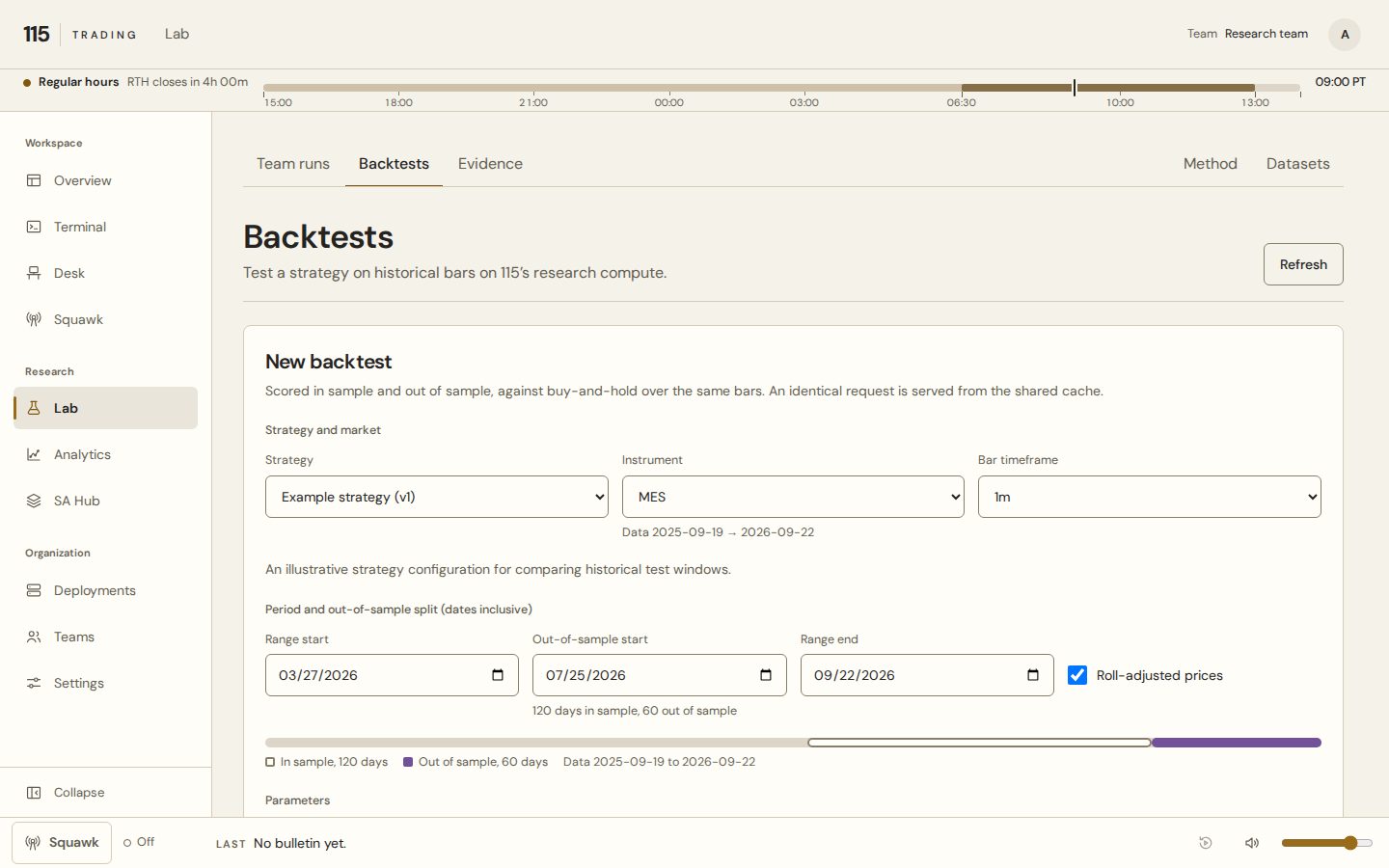
A time machine for strategies: optimize on one window of history, prove out on the window immediately after, roll forward across years and regimes. Most ideas die here.

04

The squawk

A spoken channel on a program schedule that follows the session, so the operator can step away from the glass and stay in the loop. It stays quiet unless the event is worth interrupting for.

05

Agentic operations

Named agents assemble context, run research and backtests, and keep the desk observable. They propose; a person takes every action that touches risk or the live order path.

06

Self-optimizing modelsbeta

A generation of models that re-tune as new data arrives. What has to be proven is not one parameter set but the re-tuning habit itself — which is exactly what walking forward tests.

07

A model gateway

The desk never names its model. It holds an address and an alias, asks at runtime what is actually being served, and puts the answer on a health panel a person looks at.

08

Data we build

Research runs on history we ingest, clean and store ourselves, alongside a live news wire the desk reads on air. Owning the pipeline is what makes a replay reproducible a year later.

09

Risk and recovery

The session will not open until a human has declared today's loss limit, and the desk says so in amber when there isn't one. The automated limit layer beside it is written and tested but deliberately unwired: a risk check that fires wrongly is worse than none.

The walk-forward lab

Test it on the week that hadn’t happened yet.

A single backtest proves one thing: a strategy can memorize the past. The lab takes the answers away — optimize on a window the strategy may learn from, then run it untouched on the window immediately after, record what happened, and roll both forward.

How an idea earns capital
LabThe goal, stated before the search
The lab's goal band: a written target for the strategy — clear the round-turn cost hurdle net, out of sample — above four gates it has to pass, each with its threshold and its current measurement.

The bar is written down before the search starts, and the gates are measured against it. A run that clears nothing still reports.

143hypotheses
0survived

The last go/no-go screen put 143 candidates — 24 features across six horizons — through five gates. Nothing survived; the best deflated Sharpe was 0.63 against a 0.95 bar. It also found that the cost hurdle we had been quoting was commission only and ignored the spread, which had been making everything look easier to clear than it was. Both are cheaper to learn here than in the market.

The squawk

A desk that talks, and mostly doesn’t.

Old floors had a squawk box so traders could keep their eyes on the tape and their ears on the room. The harness has one: a spoken channel on a program schedule that follows the session.

It subscribes to the same event stream the engine produces, so what you hear is what happened — not a summary assembled afterwards. The hard part was never the speaking; text-to-speech is solved. The hard part is choosing what not to say, because a channel that talks constantly trains you to stop listening.

SquawkLive read · today's program
The squawk pane: a live on-air indicator, the station lockup reading THE 115 SQUAWK, streaming live from San Francisco, the next scheduled programme, and the stop, brief-now and volume controls.

The same cloned voice narrates every research note on this site.

Good Morning SF
Overnight, the open ahead, and what changed while nobody was watching.
Opening Bell
The first prints, and whether the session opened the way the desk expected.
Power Hour
Positioning into the last hour.
Closing Bell
What the session actually did, before anyone tells a story about it.
After Hours
Anything that moved after the print.
The line

The agents propose. A person acts.

Automation here buys reach, not authority. Agents assemble context, run the boring work, and lay out options; the human takes every action that touches a risk limit or the live order path. It is a rule rather than a preference, for a plain reason: something that can be wrong should never be the last checkpoint before the market.

01One name on the trade.

Nothing reaches the market without a person who is answerable for it.

02Out-of-sample, or it doesn't run.

A result measured on data the model was fitted to is not a result.

03Costs are modeled, not assumed.

Spread, slippage and fees are attached from the first run, not the last.

04The loss limit is set before the open.

The desk asks for today's stop at the start of the session, and says so in amber when there isn't one.

Research

Notes from the desk, read in the writer’s own voice.

Occasional writing on market structure, models, and the engineering behind a systematic desk. Every note has an audio version narrated by a cloned model of the writer’s voice, and a play-all mode runs the archive end to end.

All 15 notes
Contact

One way in: a message.

No demo, no waitlist, no capital raise, nothing to buy. If you have a question about the research, a hard systems problem, or a correction to something on this site, write to the desk.

Write to the desk